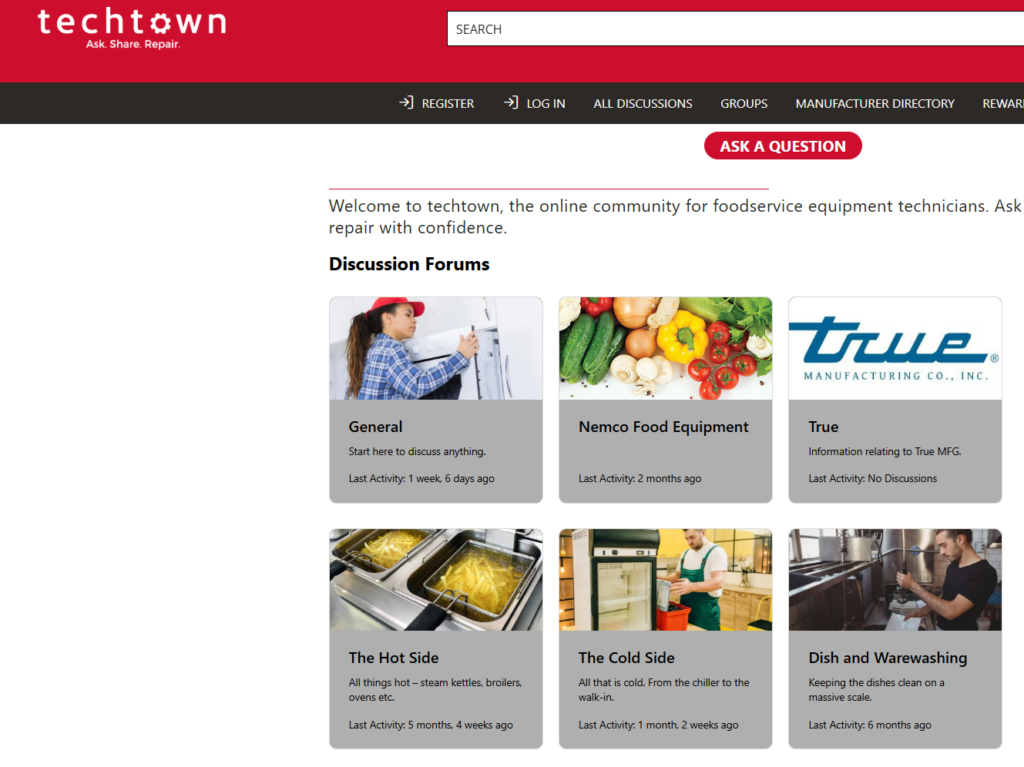
Escaping vendor lock-in, preserving 45,000 posts, and turning participation into meaningful rewards
Organization: Parts Town
Year: 2019
Role: Community Manager • Product Strategy • Platform Migration • Member Experience
Audience: Certified foodservice-equipment repair technicians
Disciplines: Community Strategy • Product Development • Gamification • UX Research • Technology
Results: 400% increase in new-member registrations • 500% increase in engagement • $140,000 in annual hosting savings
The Human Problem, Not the Software Problem
In 2019, I joined PartsTown with a clear assignment: help resurrect a declining online community of foodservice-equipment technicians.
The community had performed well after its original launch and had developed into a largely self-supporting resource. Technicians shared knowledge, answered questions, and helped one another solve difficult repair problems.
After several months, however, participation began to fall rapidly. My job was to understand why—and bring the community back to life.
What initially appeared to be an engagement problem soon revealed a much larger technical and strategic challenge.
A Community Trapped Inside Its Platform
The existing community was hosted on an expensive proprietary platform that locked the company into a single vendor. The software had not received a meaningful update in more than three years, yet the company continued paying substantial monthly hosting fees.
The platform could not support our plans for future growth. Features members increasingly expected—such as social sign-in, timely alerts, improved profiles, and mobile access—were either unavailable or outside our control.
More seriously, the community’s data was effectively trapped.
The vendor offered no practical backup, export, or migration capability. That included:
- The member database
- The existing community structure and topics
- More than 45,000 forum posts
- Years of accumulated search authority and inbound links
It initially appeared that leaving the vendor would require abandoning the community’s entire history.
The SEO Reality
Before considering a replacement platform, I studied how people found and used the existing community.
More than 95% of its traffic came from search engines. Technicians searching for answers were landing directly on years-old discussions and repair advice. This advise was immensely important and is to this day still the foundation of the entire community.
That led to a stark conclusion: starting over was not a viable option.
A new community could succeed only if we remained with the existing vendor or found a way to preserve and migrate the content while maintaining its established URLs and search visibility.
The project’s future depended on solving the migration problem first.
Finding a Way Out
Because the vendor provided no export tools, we needed to develop our own extraction and migration process.
At the same time, I began evaluating replacement community platforms. One requirement guided the search:
We would never allow the community to become trapped again.
That eliminated many proprietary hosted platforms. Whatever we selected needed to provide control over the software, database, content, and future migration options.
WordPress offered the open foundation we needed. Its community ecosystem included BuddyPress, along with extensive documentation and a flexible data structure that could accommodate the content extracted from the existing platform.
During my research, I discovered BuddyBoss, which extended that community foundation with capabilities such as private groups, learning features, and support for a customized mobile experience.
With BuddyBoss, I had found the potential new heart of the community.
The Migration Plan
The project was no longer simply a redesign. It became a complete community rescue and relaunch.
The plan included:
- Create a new identity, domain, logos, video assets, email templates, mobile experience, and more than 200 supporting brand assets.
- Document the existing community’s structure and reproduce it in a sandbox environment.
- Select the new platform features and determine how they should fit into the user experience.
- Build tools to extract the existing community and map its content into the new database.
- Conduct test migrations and verify the imported users, topics, posts, and relationships.
- Run user-acceptance testing with existing community members.
- Incorporate member feedback into the platform.
- Plan the final migration inside a three-hour window to minimize downtime.
- Map old URLs to their new destinations and test redirects to preserve search traffic.
- Prepare a complete relaunch campaign and contingency plan.
The technical migration mattered, but moving the data alone would not bring the community back to life. We also had to understand why members had stopped participating.
Designing Around Real Member Behavior
We observed members as they navigated the existing platform and documented points of friction.
Users previewed the replacement site and completed common activities such as creating posts, replying to discussions, and finding information. We interviewed highly active contributors to understand what kept them coming back. We also spoke with less-active members to learn why they rarely visited.
The research uncovered missing features that users considered basic, including useful site notifications. More importantly, it revealed that members had little incentive to return regularly.
The existing community offered information, but it did not consistently recognize or reward the people contributing that value.
Beyond Meaningless Points
Traditional gamification systems often rely on points, badges, and leaderboards. Our members were clear: they would not return simply to accumulate points that had no practical value.
That feedback exposed an opportunity.
Instead of asking members to compete for meaningless status, we could allow them to exchange their participation for physical rewards.
That idea became TechTown Rewards: a gamification system that connected valuable community activity to a real merchandise store.
Members would not merely collect points. They could spend them.
Connecting Participation to Physical Rewards
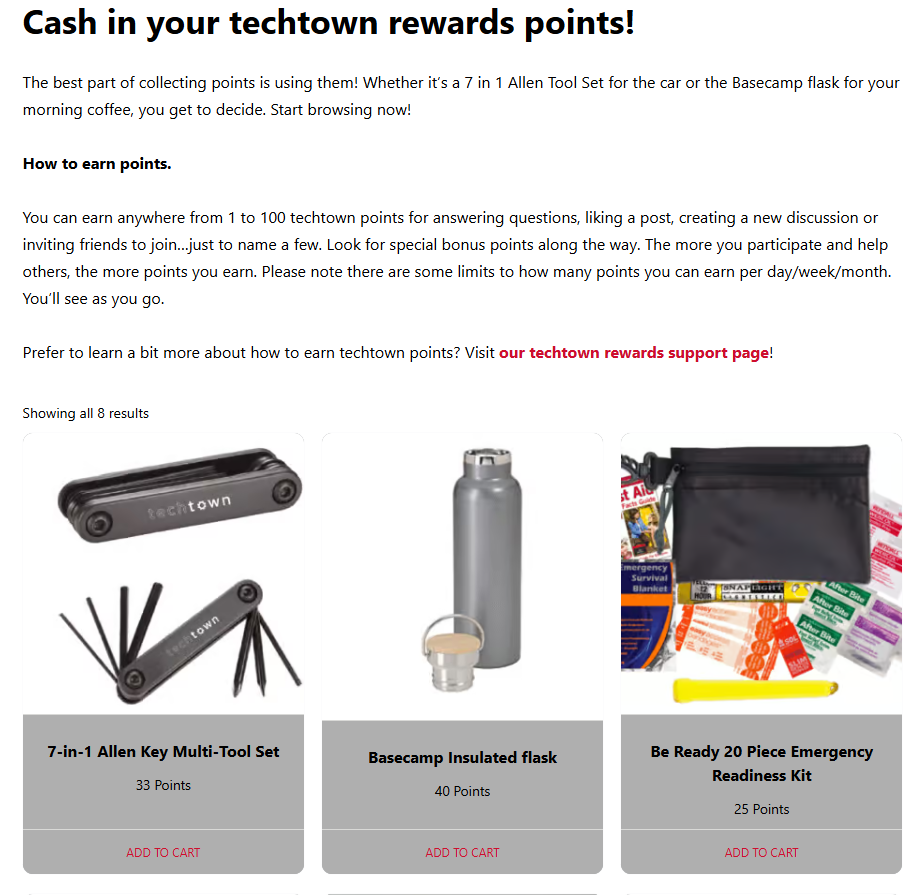
WordPress gave us the flexibility to assemble the system from several interoperable components.
WooCommerce provided ecommerce and order-fulfillment capabilities. GamiPress allowed us to recognize community activity and award points. We then developed a custom integration connecting the gamification system with the WooCommerce store.
I selected merchandise for the rewards catalog and defined the activities that could earn points, including:
- Daily, weekly, and monthly visits
- Connecting a social account for easier sign-in
- Publishing a new post
- Replying to another member
- Receiving votes for a helpful answer
- Providing the highest-rated answer after five days
- Creating a new group
- Downloading the mobile application
- Reaching a membership anniversary
- Celebrating a birthday
- Joining the email list
- Visiting the blog
- Commenting on a blog post
These activities encouraged participation while also giving us much better insight into how members used the community.
The system was designed to reward actions that strengthened the community—not activity for activity’s sake.
Technical Foundation
The finished platform combined:
- WordPress for the primary website and blog
- BuddyBoss for community functionality
- WooCommerce for the rewards catalog and order fulfillment
- GamiPress for points and activity-based rewards
- Yoast SEO for search optimization
- Wordfence for platform security
- A custom developed plugin connecting GamiPress points with WooCommerce purchases
- Additional tools for backups, analytics, and operational support
Because the platform was built on an open and exportable foundation, PartsTown retained control over its community and its data.
Preparing for Launch
Once the platform and migration process were ready, we installed the new community on its dedicated domain.
Before launch, we:
- Completed a final test of the extraction and migration process
- Notified members of the upcoming changes and expected downtime
- Verified URL mappings and search redirects
- Prepared contingency plans for possible migration errors
- Scheduled the final transition inside a three-hour window
During the migration, we extracted the latest community content, imported it into the new platform, updated the domain configuration, and waited for DNS changes to propagate.
We then tested the community one final time and reopened it to members.
A live analytics dashboard allowed us to watch the impact of the relaunch as it happened. Three weeks later, we began work on the mobile application.
Results and Impact
According to our first-month measurements, the migration and relaunch produced immediate results:
- $140,000 saved annually in community-hosting expenses
- 400% increase in new-member registrations
- 500% increase in member engagement
- 250% increase in new topics published
- Elimination of dependency on the former proprietary platform
- Control and portability of the community’s data
- A technical foundation capable of supporting future features and a mobile application
The platform did more than reduce costs. It restored momentum to the community while protecting the knowledge its members had created.
What Made the Project Different
The individual technologies were established open-source products. The innovation came from how we combined them and the problem that combination solved.
Notable elements included:
- Migrating a large, search-dependent community away from a platform with no supported export process
- Preserving more than 45,000 posts and their established URLs
- Connecting community gamification with fulfillment of physical merchandise
- Designing the new platform through direct observation and interviews with existing members
- Building an open foundation from which the organization could export and migrate its data in the future
- Extending the experience into a dedicated mobile application
Looking Back
This project taught me to evaluate every software-as-a-service platform with one critical question:
Can we leave—and can we take our data with us?
Vendor lock-in is not an abstract technical concern. Vendors stop supporting products, change direction, raise prices, or close entirely. When the information at risk represents years of contributions from a living community, losing access can be devastating.
I was proud to leave TechTown in new hands knowing that its data remained available to its rightful owner. If another migration becomes necessary, the community can be exported instead of reconstructed through another rescue operation.
I was equally grateful that Parts Town supported genuine member research. Observing and interviewing existing users proved essential to charting the community’s future. Several of the platform’s most important features existed because members told us what they needed—and we listened.
The project began as an assignment to revive engagement. It became something larger: the rescue of a community, its accumulated knowledge, and its ability to control its own future.
Project Snapshot
| Category | Details |
|---|---|
| Project | TechTown community migration and rewards platform |
| Organization | Parts Town |
| Year | 2019 |
| Role | Community Manager, Product Strategy, Platform Migration, Member Experience |
| Audience | Certified foodservice-equipment repair technicians |
| Content preserved | More than 45,000 forum posts |
| Core technologies | WordPress, BuddyBoss, WooCommerce, GamiPress, Yoast SEO, Wordfence |
| Custom development | GamiPress-to-WooCommerce rewards integration |
| Annual savings | $140,000 |
| First-month results | 400% registration growth, 500% engagement growth, 250% growth in new topics |
| Long-term value | Community ownership, data portability, extensibility, and removal of vendor lock-in |